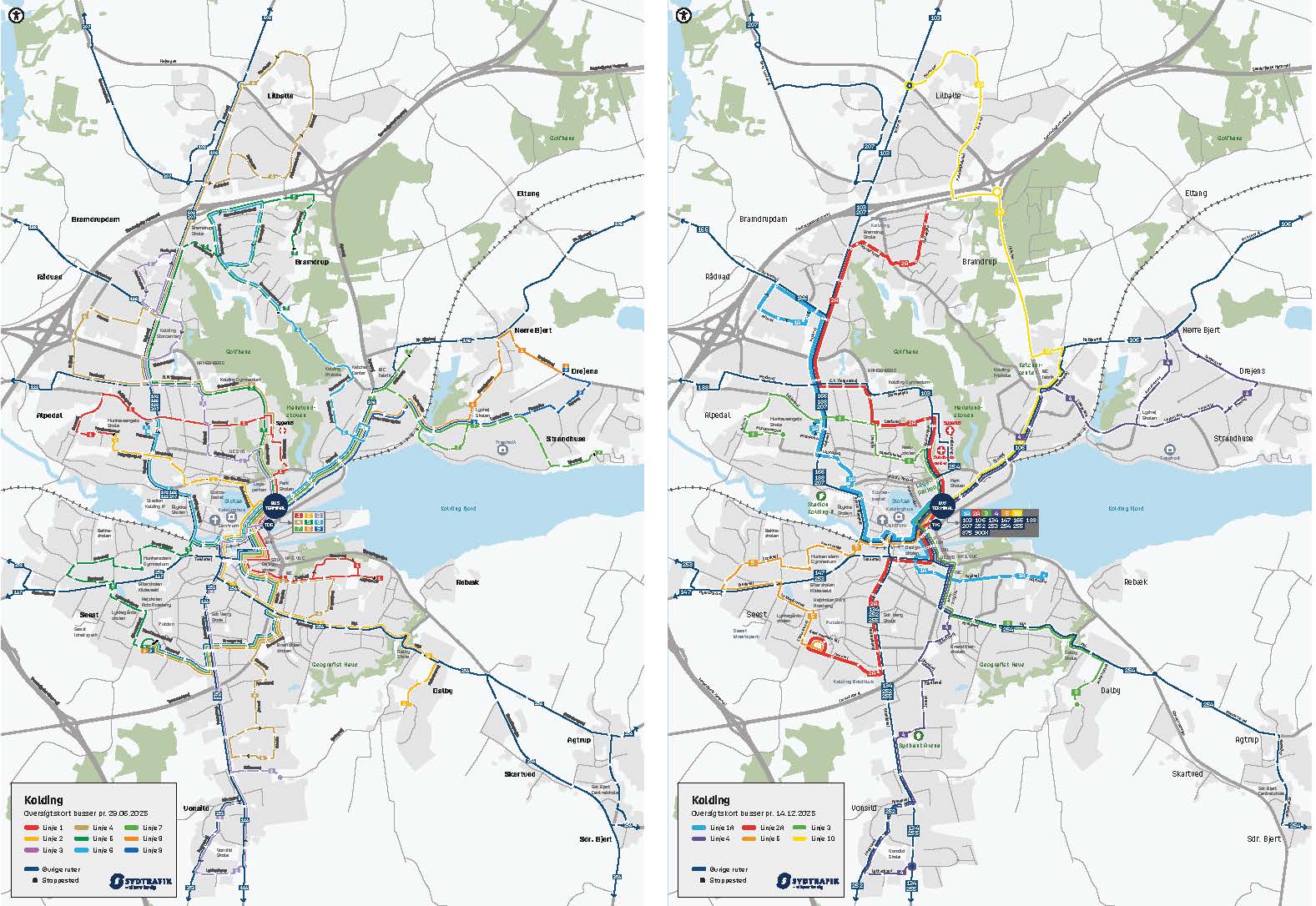
On 14 December 2025, Kolding will wake up to a completely different bus network. The familiar system with nine city lines will be replaced by two high frequency A lines, a handful of ordinary city lines, a commuter route and a new flex route, and several of the regional routes that many of us have used for years will either be redirected, split up or disappear from some areas altogether. On the surface this looks like a modern upgrade that belongs in a growing city: shiny maps, simple line numbers, promises of more departures and a clearer structure that is easier to understand. For many people who live along the new main corridors, that promise will be real and they will feel the improvements in their daily lives.
But if we look beyond the polished diagrams and the official headlines, we start to see a very different story unfolding for a large group of residents, especially those in rural villages, in the small pockets of housing away from the main roads and for people who, because of age, illness or disability, simply cannot walk long distances or climb hills to reach a bus stop. For them, this new plan does not feel like an upgrade. It feels like a step backwards, a slow closing of doors, a signal that efficiency and budgets have been placed above fairness and access.
I am writing this not as a traffic expert with models and spreadsheets, but as a resident who listens to people in our municipality, who sees how children, students, nurses, shop workers, elderly neighbours and wheelchair users actually move through Kolding in real life. I can see that the new plan has good intentions and real strengths, but I also see how it risks leaving many people behind, and I believe we have to talk honestly about both sides if we want a bus system that serves all of Kolding and not only the busiest parts of the map.
What The New Bus Network Promises To Deliver
If we listen to Kolding Kommune and Sydtrafik, the message is clear and in many ways understandable. The old network is described as tangled and confusing, with lines that twist through side streets, loops that try to cover every corner and timetables where buses often come only once an hour. That kind of system is hard to sell to people who have the option to jump into a car, and it is not surprising that many commuters and students have chosen to drive instead of waiting for a slow and irregular bus.
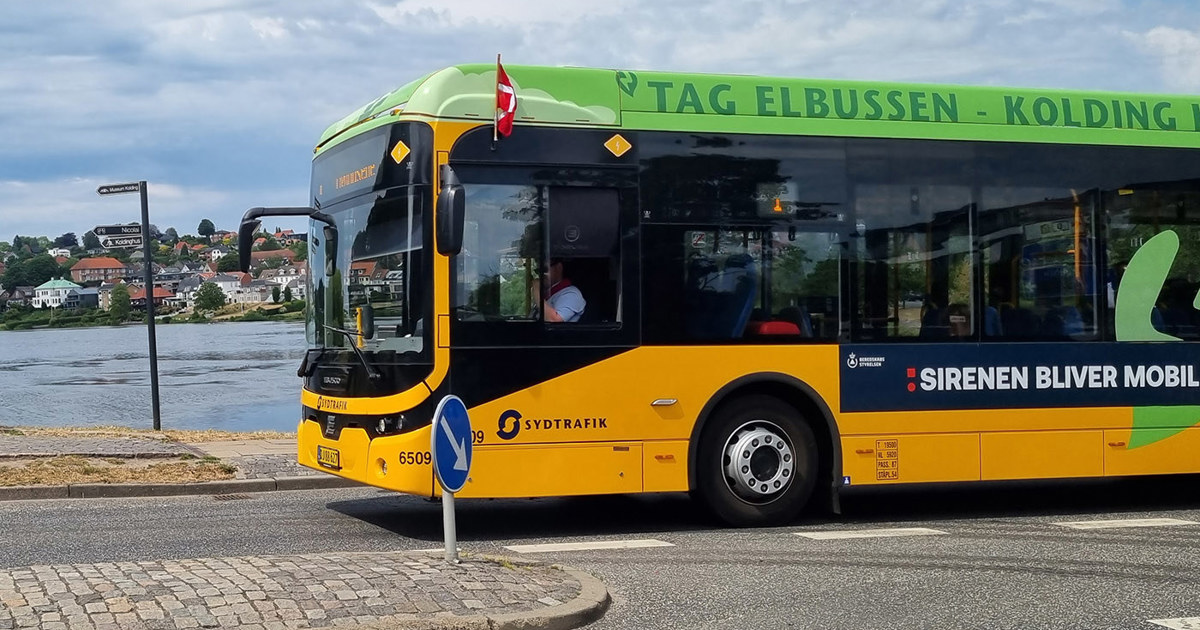
The new network is built around a different logic. Two A lines, 1A and 2A, will run with high frequency on the main corridors, connecting Kolding Sygehus, the big educational institutions, Kolding Storcenter, large housing areas and the central bus terminal. On weekdays during the day the A lines will come roughly every 15 minutes and in the evenings and at weekends they will still run more often than what many areas are used to today. Around these A lines there will be a smaller set of ordinary city routes, including line 3, 4 and 5, and a more targeted commuter line 10 to Lilballe and the industrial areas, while a new flex route is meant to give some kind of connection where the normal buses no longer go.
If you live along Vejlevej, Skovvangen, Skamlingvej or close to the hospital, Storcenter or campus, this all sounds very promising. It means shorter waiting times, more direct routes and less stress about missing a bus and then being stuck for an hour. For students who have evening classes, for young people with part time jobs, for people working shifts at the hospital or shops, a system with frequent buses can genuinely make it easier to leave the car at home or not buy a car at all. In that sense the new plan does bring Kolding closer to the kind of public transport you find in larger cities.
Where The Plan Starts To Hurt Real People
The problem is that a bus network is not only a diagram of lines and numbers. It is also all the little pieces of life that depend on those lines: the grandmother who takes the bus to visit her grandchildren, the student who works late in a fast food place, the man on crutches going to physiotherapy, the teenager in a village trying to get to sports practice, the chronically ill patient who needs reliable access to Kolding Sygehus. When we change the network, we are not just moving lines on paper, we are reshaping how easy or how hard it is for people to live an independent life.
In the new plan, many of the old loops and side routes disappear. Some neighbourhoods inside Kolding lose their close by stops and are told to walk further to reach an A line or a remaining city bus. In areas like Rebæk, Harte, Sjællandskvarteret, Bornholmerkvarteret and along the lower part of Agtrupvej, residents will have to accept that their nearest bus stop is no longer around the corner but maybe several hundred meters away, possibly uphill, possibly across a busy road. For a young, healthy person on a sunny day this may seem like a minor detail. For an elderly person with a walker, a parent with a pram and two small children or a person with heart or lung problems, this is not a small adjustment. It can be the difference between using the bus and giving up.
When we move out of the city and into the villages, the picture becomes even more worrying. Some rural areas that today have a fixed route bus will lose it completely and will be sent over to Plustur or Flextrafik. If you live in a place like Binderup, Grønninghoved or in parts of the coastal area that have been linked to route 254, you will now be asked to book your transport in advance, wait for a car or minibus that may drive long distances empty to pick you up and then pay a higher price for a service that is less predictable and less flexible than a simple timetable with a bus you can wave down.
In theory, Flextrafik is presented as a solution that covers everyone. In reality, many people experience it as something else: a system that is complicated to book if you are not used to apps or online forms, a service that removes the freedom to make spontaneous trips, a form of transport that is more like a taxi subsidy than a true public bus line. It may work for some journeys and some people, but it is not an equal replacement for losing the only bus line in your village.
How This Feels If You Do Not Live On An A Line
If you live on Skovvangen, near the Storcenter, close to campus or along one of the new main corridors, you might read the official communication and think that the criticism is exaggerated. You will see shiny new maps, you will try the A lines and you will feel the benefit of not having to plan your day around a bus that only comes once an hour. But if you talk to someone who lives in a side street that has lost its local loop, or in a village now without a scheduled bus, you will hear a very different story.
Imagine being an 80 year old woman in a residential street that used to have a bus stop just down the road. You could slowly walk there with your walker, sit on the bench, get on the bus and go into town to shop, visit friends, see your doctor or simply feel like you were part of the community. Now that stop is gone and the nearest one is perhaps 500 or 600 meters away up a hill. On a dry summer day with good energy you may still manage. On a wet, windy day in February, or when your health is a little worse, you may decide to stay at home. The distance on the map is not big, but the distance in your life becomes enormous.
Or think about a teenager living in a rural village where the bus is being removed. Before, there was at least a bus in the morning and one in the afternoon that could take them to school, sports or a weekend job. Now they are told to use Flextrafik or that parents can drive them. But what if the parents work shifts or do not have a car? What if the family is trying to save on fuel costs? Slowly, the young person starts saying no to social activities or spends hours waiting for rides. We talk a lot about integration, youth wellbeing and equal opportunities, but we cannot ignore how basic transport plays a quiet but powerful role in shaping those things.
The Hospital Question That Will Not Go Away
One of the most emotional parts of this reform is access to Kolding Sygehus. On paper, the new plan looks better: the A lines and some regional routes are shown as passing close to the hospital area, and in political negotiations there has even been talk of extending routes specifically to serve the hospital. In official documents, you will find clear statements that the hospital is a key node in the new network.
However, anyone who has tried to visit the hospital with mobility challenges knows that drawing a line past a hospital on a map is not the same as making the hospital easy to reach in real life. For someone in a wheelchair, for a person using crutches after surgery, for a cancer patient who is exhausted from treatment, or for an elderly person who moves slowly and carefully, details matter. Is the bus low floor and truly easy to board independently, or does it require awkward steps and a nervous struggle with a ramp. Is the stop placed close to the main entrance, or does it require a long walk across open space in all kinds of weather. Are there benches and shelter if you need to sit down while you wait, or are you left standing. How often does the bus run after 18.00, when visiting hours are still ongoing and many people are trying to get home.
In the new network, several stops that were close to the hospital are removed and replaced with stops farther away. For a planner looking at a map, the change may seem minimal. For a frail patient or an elderly partner carrying a bag and walking slowly, the extra distance and the slope can feel like a mountain. This is why many residents and some local politicians have reacted so strongly to the idea that we now have to be satisfied with a theoretical line serving the hospital, while the practical access for those who need it most becomes more demanding.
Rural Inequality And The Climate Argument
We often hear that the new bus plan is part of a greener future, where more people choose public transport and fewer cars crowd our streets. Inside the city, especially along the A lines, that vision may actually come true. More frequent buses that are easy to understand will encourage some people to leave the car at home, and this will reduce congestion and emissions in central Kolding. That is a real and important gain.
But a municipality is more than its city centre. When we remove fixed buses from rural areas and tell people in villages to either book Flextrafik or use their private cars, we are not supporting a green transition for those residents. We are gently but firmly pushing them back into their vehicles. Flextrafik vehicles often travel long distances with just one passenger or even empty, driving to pick someone up. Parents who might have let a teenager take the bus to school or sports now have to drive them instead. Elderly people who no longer feel safe walking to a distant stop will choose taxis or rely on relatives with cars. In practice, this means more car kilometres driven and higher emissions in precisely the parts of the municipality where distances are long and alternatives are few.
So while the plan may generate a climate benefit inside Kolding city, it also risks increasing pollution in the rural and semi rural zones. If we are serious about climate goals for the whole municipality, not just for the streets around the town hall, then this contradiction needs to be acknowledged honestly. A green mobility plan cannot simply write off the countryside as too expensive to serve.
Is This Really Just About Modernising, Or Is It Also About Money
There is no point pretending that money is not part of this story. The municipality has not put a large new sum on the table to fund extra bus service. At the same time, the cost of drivers, fuel and maintenance has gone up. In that situation, if you want to offer more frequent service on some lines, you have to cut somewhere else. The new plan chooses to cut in the less populated areas and the small side loops in order to free up buses and drivers for the A lines and the busiest corridors.
From a narrow financial point of view, this is logical. It is cheaper to move many people along a few main corridors than to drive half empty buses around every corner. From a human point of view, it is much harder to accept, because the savings are taken from the people who are least able to compensate: those without cars, those with limited mobility, those living in villages where even a small reduction in service can feel like being left behind by the rest of the municipality.
The new network is often described as a technical optimisation. In reality, it is a political choice about whose mobility counts the most when money is tight. The benefits are concentrated in areas that already have many advantages, while the costs land on shoulders that are often already carrying a heavy load.
How We Could Do Better For The People At The Edges
None of this means that Kolding should throw away the idea of A lines or go back to a confusing network where buses crawl around every side street once an hour. A simple, frequent core network is a good idea. The question is how we make sure that the people who do not live on that core are not left to solve transport on their own. If we really want a fair and modern system, we have to be willing to adjust and to invest in solutions that also work for those at the edges of the map.
We could, for example, look at small rural feeder buses that run on fixed mini routes, even if only once an hour, linking villages to the nearest A line stop or bus terminal. We could create a dedicated hospital shuttle that connects major neighbourhoods and some of the larger villages directly to Kolding Sygehus, so that people with fragile health are not forced to navigate long walks and multiple changes. We could review which neighbourhoods have a particularly high share of elderly or mobility impaired residents and restore some form of local loop there, even in a limited way, rather than expecting everyone to walk to a main road.
We could also be more honest about the limits of Flextrafik and work to make it more user friendly and better integrated with timetabled buses, instead of treating it as a magic solution that automatically replaces a lost line. Most importantly, we could commit to a serious follow up: measure over the next year how many people in affected areas stop using public transport, how many cancelled or missed medical appointments are related to transport, how many young people in rural villages find it harder to participate in education, work or leisure activities. Real data and real stories should guide the next round of adjustments.
What This Change Says About The Kind Of Kolding We Want
In the end, the new bus plan is about more than routes and timetables. It is a mirror that shows us what kind of city and municipality we want to be. Do we accept a model where we build a strong, fast and comfortable core network for those who live along the main corridors, while quietly asking everyone else to cope as best they can. Or do we insist that modernisation and fairness must go hand in hand, even if that costs more and requires more political courage.
I am glad that some residents will finally get a bus that comes often enough to be truly useful. I want students and workers to have real alternatives to the car and I want the centre of Kolding to be less choked by traffic. But I do not want us to achieve that by telling elderly people in side streets, families in villages and chronically ill hospital patients that their mobility is now a secondary priority. A public transport system should not divide us into winners and losers. It should be one of the things that ties a community together and gives everyone, regardless of postcode, age or income, a fair chance to participate in everyday life.
As residents, we have a right to ask more from our bus plan. We can recognise the good parts while still demanding that the voices of those who lose out are heard and that concrete improvements are made for them. This is not about being against buses or against modernisation. It is about insisting that when Kolding moves forward, we do not leave our most vulnerable neighbours standing alone at a bus stop that no longer exists.
Who Wins And Who Loses
| Group | Effect Of The New Plan |
|---|---|
| Residents along 1A and 2A | Receive much better frequency and simpler routes, making it easier to use the bus every day and to plan life around public transport instead of a car. |
| Students and campus users | Gain faster and more frequent access to education, part time jobs and evening activities, which supports study life and work opportunities. |
| Commuters to Lilballe and business areas | Benefit from a clearer commuter line that is designed to fit working hours and connects job areas more directly to the city. |
| Rural villages like Binderup and Grønninghoved | Lose fixed buses and become more dependent on cars and Flextrafik, with fewer spontaneous travel options and more complexity in daily life. |
| Neighbourhoods losing local loops | Face longer walking distances to stops, which makes everyday errands and social visits harder, especially for elderly residents and families with small children. |
| Hospital users with limited mobility | Experience more walking and more effort to reach Kolding Sygehus by bus, making treatment visits and patient support more demanding. |
Climate Impact In Urban Versus Rural Areas
| Area Type | Expected Change In Car Use | Expected Change In Emissions |
|---|---|---|
| Central Kolding along A lines | Car use is likely to decrease because buses become more attractive for daily travel and for evening and weekend trips. | Emissions per person are likely to decrease in these corridors, as more passengers share each bus journey. |
| Neighbourhoods with fewer stops but still some buses | The effect is mixed. Some people will continue to use buses, while others may choose cars more often when the walk to the stop becomes longer. | The overall impact is uncertain and depends on how many people change their behaviour in practice. |
| Rural villages that lose buses | Car use is likely to increase strongly because fixed bus options disappear and Flextrafik cannot fully replace them for everyday transport. | Emissions per person are likely to increase, as more individual car journeys replace the shared bus trips that did exist before. |
References And Sources
- Kolding Kommune - "Nyt busnet i Kolding"
- Sydtrafik - Køreplaner og bykort for Kolding Kommune
- Old bus network map (June 2025)
- New bus network map (from 14 December 2025)
- Vores By Kolding - "Kolding får nyt bybusnet med hyppigere afgange, flexrute og justerede planer fra december"
- Christiansfeld Avis - "Hurtigrute fra Hejlsminde til Kolding, men ingen bus til bl.a. Skamlingsbanken"